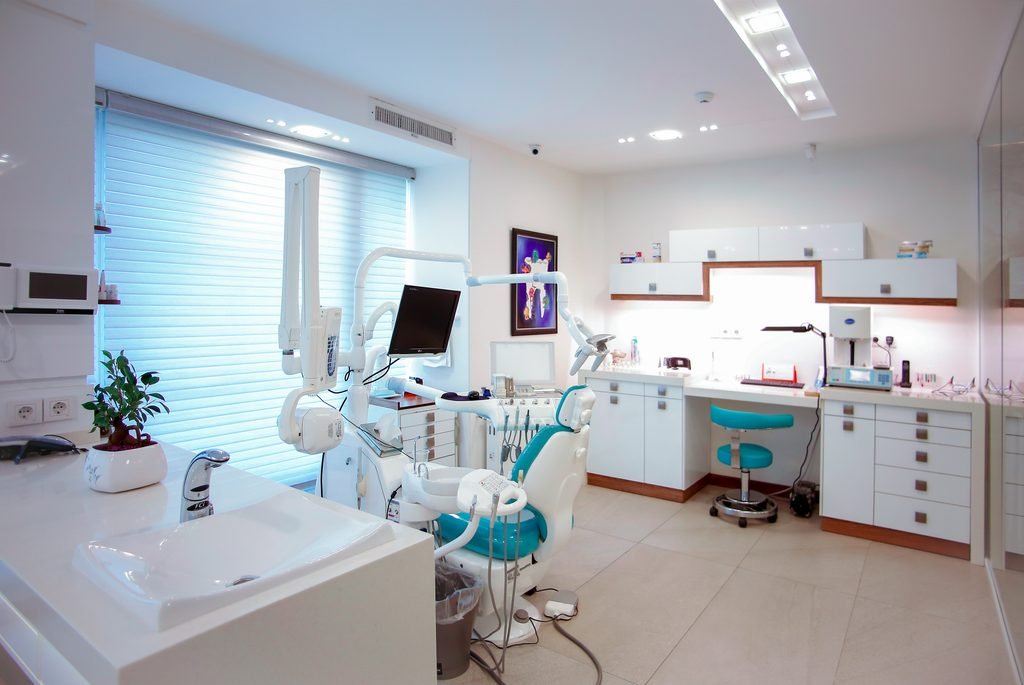

Opening a private clinic requires more than clinical expertise and a suitable location.
You also need to know how much the clinic will cost to operate, how much each patient contributes to your revenue, and how many patients you need to see each month to make the practice financially sustainable.
This is where private clinic economics becomes important.
Before opening, calculate these five numbers. They can help you understand your break-even point, set realistic patient-volume targets and make better decisions about your clinic budget.
1. Your Monthly Fixed Costs
Fixed costs are expenses you generally need to pay even when patient numbers are low.
These may include:
- Clinic rent and maintenance
- Receptionist and staff salaries
- Utilities and internet
- Software subscriptions
- Accounting and administrative expenses
- Equipment financing or other fixed repayments
Add these expenses to estimate your monthly operating baseline.
For example, if your rent is ₹20,000, staff costs are ₹25,000, and other fixed expenses total ₹15,000, your monthly fixed costs would be ₹60,000.
This is only an illustration. Actual costs will vary significantly by specialty, location and clinic size.
2. Your Variable Cost Per Patient
Not every rupee earned from a consultation necessarily contributes to your profit.
Variable costs increase as you treat more patients. Depending on your specialty, these may include consumables, disposables, laboratory charges or other costs directly associated with a consultation or procedure.
Estimate the average variable cost per patient using your expected mix of services.
For example, a dental clinic may have very different costs for a routine consultation, dental cleaning and restorative procedure.
Where treatment costs vary substantially, consider calculating the economics of individual services rather than treating every appointment as identical.
3. Your Average Revenue Per Patient
Your consultation fee is not necessarily the same as your average revenue per patient. Some patients may require only a consultation, while others may receive additional procedures or services. Estimate your average revenue using realistic assumptions about the services your clinic expects to provide.
For example, if 100 completed visits generate ₹50,000 in revenue, your average revenue per visit is ₹500. Don’t build your business plan around the assumption that every patient will purchase additional services.
4. Your Break-Even Patient Volume
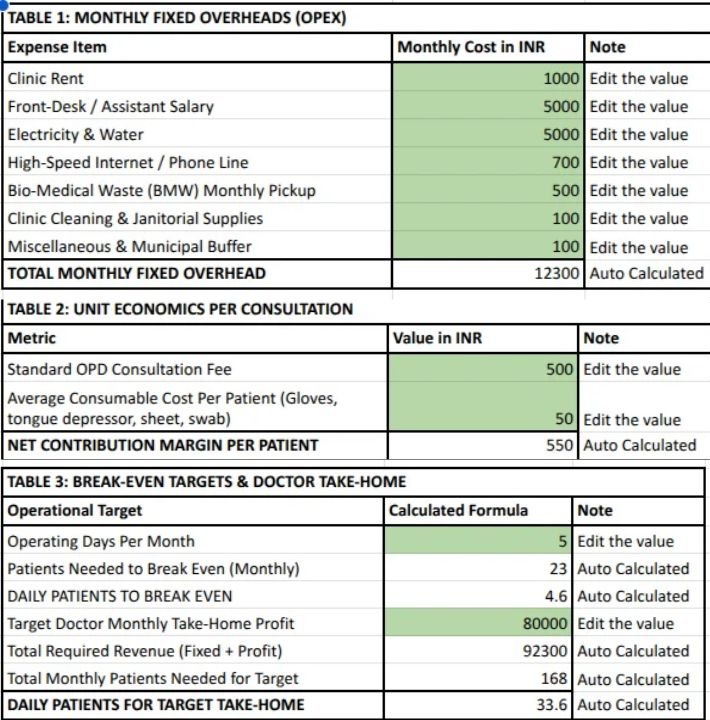
This is one of the most important numbers to know before opening.
Your break-even patient volume tells you approximately how many completed visits you need to cover your operating costs based on your assumptions.
The basic formula is:
Break-even visits per month = Monthly fixed costs ÷ Contribution per visit
Where:
Contribution per visit = Average revenue per visit − Variable cost per visit
For example:
| Metric | Illustrative amount |
|---|---|
| Monthly fixed costs | ₹60,000 |
| Average revenue per visit | ₹500 |
| Variable cost per visit | ₹100 |
| Contribution per visit | ₹400 |
| Break-even visits per month | 150 |
| Break-even visits per day | About 6* |
*Assuming 26 working days.
In this example, the clinic needs approximately 150 completed visits a month to cover the specified costs.
This simplified calculation does not automatically account for every possible expense, including taxes, loan principal repayments, depreciation or the doctor’s desired personal income. Include the relevant items in your broader financial plan.
5. Your Patient Volume Target
Knowing your break-even number tells you how many patients you need. The next question is how you will reach that number.
This is where patient flow becomes a business metric rather than simply a marketing term.
Think about your patient journey:
Local discovery → Enquiry → Appointment → Consultation → Follow-up → Return visit
A gap at any stage can reduce your actual patient volume.
For example, if your clinic needs 150 completed consultations a month but receives only 100 enquiries, the immediate problem may be patient acquisition.
If you receive 200 enquiries but only 80 become appointments, the problem may be your enquiry-to-booking process.
If you book 150 appointments but only 110 patients attend, missed appointments and reminder systems may need attention.
This is why knowing how to increase patient volume in medical practice starts with identifying where patients are being lost.
How to Increase Patient Volume in a New Clinic

Once you know your target, you can work backwards. If you need more patients, start with the fundamentals:
Improve local visibility
Make sure patients in your area can find accurate information about your clinic through Google and other relevant local channels.
Make enquiries easier to convert
Your receptionist should have clear processes for handling questions about fees, timings, location and appointments.
Reduce avoidable no-shows
Use appropriate appointment reminders and make rescheduling straightforward.
Build local awareness
Community initiatives such as appropriate health-awareness programmes, residential society activities and ethical local partnerships can help a new clinic become known in its neighbourhood.
Encourage appropriate follow-up and retention
A sustainable practice isn’t built only by constantly finding new patients. Increasing patient retention through good clinical care, clear follow-up communication, and a positive patient experience can contribute to more consistent patient flow.
The objective is not simply to get as many patients as possible. It is to build a patient volume that your clinic can serve safely and sustainably.
Don’t Spend Your Entire Budget Before Opening
A common mistake is to spend too much of the available capital on interiors, equipment or technology before understanding how much cash the clinic will need to operate.
Separate your spending into:
Essential before opening
and
Useful after the clinic starts growing
A simpler setup may leave you with more cash available to manage the early months while you work towards your target patient volume.
Calculate Your Cash Reserve
Even a well-planned clinic may take time to establish a steady appointment schedule.
Estimate how much money you may need for:
- Initial setup and equipment
- Deposits and advance payments
- Operating expenses during the early months
- Unexpected repairs or essential purchases
- A slower-than-expected increase in patient volume
Your required reserve will depend on your actual expenses, available financing and risk tolerance.
The key is to avoid treating your entire opening budget as money that must be spent before launch.
Track the Numbers After Opening

Your pre-opening calculation is only a starting point. Once your clinic is operating, track:
- Number of enquiries
- Appointments booked
- Completed consultations
- Cancellations
- Missed appointments
- New versus returning patients
- Average revenue per consultation
- Monthly operating costs
These numbers can tell you how to get more patients in your practice more intelligently.
For example, if:
- Enquiries are low, you may need to work on local visibility and awareness.
- Enquiries are high, but bookings are low, examine your reception and appointment process.
- Bookings are high but completed visits are low, look at reminders, cancellations and rescheduling.
- New-patient numbers are healthy but returning-patient numbers are weak; examine the patient experience and appropriate follow-up process.
Your Clinic’s Patient Target Should Drive Your Marketing
- Before spending money on advertising, know what you’re trying to achieve.
- If your calculations show that you need 150 completed consultations a month, you can work backwards from that number.
- How many appointments do you need to book?
- How many enquiries do you need?
- How many people need to discover your clinic?
This is a much more useful approach than simply deciding that you need to “do more marketing.”
Your patient flow should ultimately connect your financial target with your operational and patient-acquisition systems.
Prepare Before You Open
Understanding clinic economics can help you make better decisions before committing your savings, taking on expenses or opening your doors.
But knowing your numbers is only one part of the process.
You also need practical systems for getting discovered locally, handling enquiries, booking appointments, managing reminders and running the front desk.
If you’re preparing to open an independent clinic, download the free 25-Point Clinic Launch Checklist to review the essential operational areas before your first patient arrives.
If you want the actual resources to implement these systems, the Doctor’s Clinic Launch Kit includes a clinic break-even calculator, appointment tracking resources, receptionist scripts, Google Business Profile and WhatsApp setup guides, patient documentation templates and reminder workflows.
The goal isn’t simply to open a clinic.
It’s to open one with a clear understanding of how much it costs, how many patients it needs and how the systems behind that patient flow will work.
Note: Examples in this article are illustrative and intended for general business planning. Actual clinic costs, taxes, financing obligations, professional requirements and patient volumes vary by specialty and location. Seek appropriate financial and professional advice for your circumstances.